
Desert Awes

Introduction
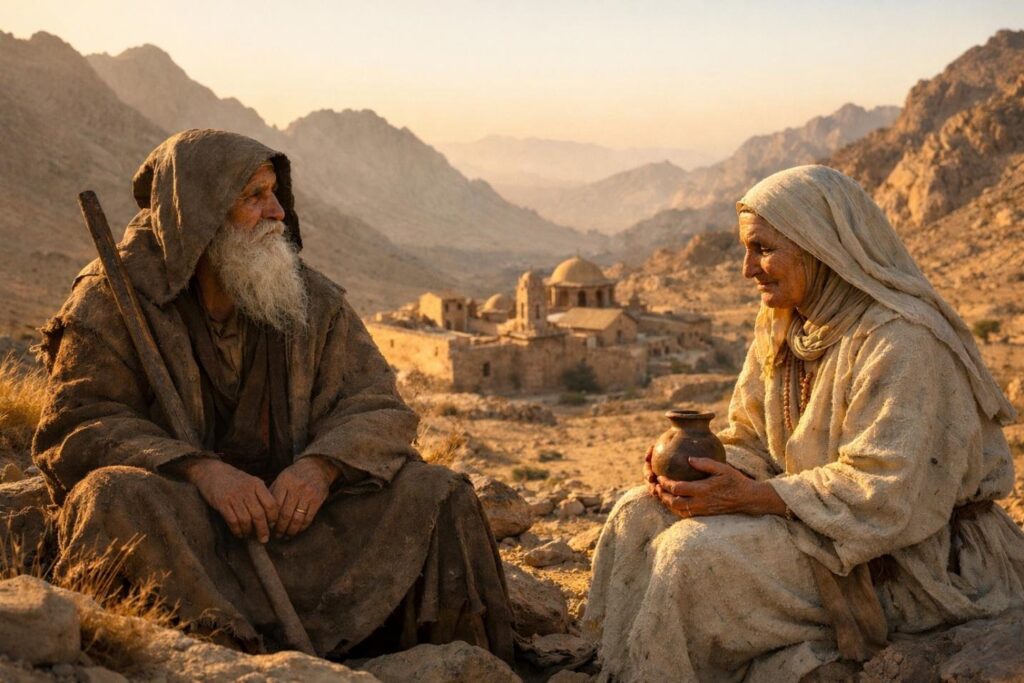
In the third and fourth centuries, as Christianity moved from a persecuted faith to an established religion, a quiet but profound movement began to unfold on the edges of the known world. Men and women left cities, villages, and social structures and journeyed into the deserts of Egypt, Palestine, and Syria. They were not fleeing the world out of contempt, nor seeking heroism or isolation for its own sake. They were searching for clarity.
These seekers came to be known as the Desert Fathers and Mothers—abbas and ammas—ordinary people who desired an undivided heart. In a time when Christianity was becoming intertwined with power, comfort, and conformity, they sensed that something essential was being lost. The desert, with its silence, simplicity, and stark honesty, offered a place where illusions fell away and the soul could no longer hide from itself or from God.
Life in the desert was not romantic. It was marked by heat, hunger, loneliness, and monotony. Yet the desert elders discovered that when distractions are stripped away, the heart becomes transparent. Prayer ceases to be performance. Faith becomes lived rather than asserted. Over time, these men and women gained a wisdom forged not through speculation, but through attention, humility, struggle, and love.
Their teachings were not written as treatises. They were preserved as short sayings, stories, and exchanges—brief, direct, and often paradoxical. These sayings were passed on because they worked. They healed. They clarified. They led people into freedom.
Desert Awes gathers this ancient wisdom into a year-long journey, drawing directly from the authentic sayings of the Desert Fathers and Mothers. Each day presents a few original sayings, followed by thoughtful interpretation and a simple AWE meditation—Aware, Wonder, Experience—designed not to explain the desert, but to help you inhabit it.
This is not a program for self-improvement. It is a pilgrimage. The desert path does not rush, accuse, or demand perfection. It trusts the slow work of God and honors the human condition with compassion. Across five stages—Awakening, Purification, Illumination, Union, and Returning to the World—the reader is gently led from noticing, to healing, to clarity, to rest, and finally to embodied love.
You are not asked to escape your life. You are invited to see it more clearly. The desert does not remove us from the world; it returns us to it, transformed. What begins in silence ends in presence. What is learned in solitude becomes a gift for others.
STAGE 1: AWAKENING – The first Spark of Light
Stage 1 marks the beginning of the desert journey. Awakening is not yet purification or illumination; it is the slow, gentle opening of awareness to God, to oneself, and to reality as it truly is. The Desert Fathers and Mothers understood that before anything in the soul can be healed or transformed, attention must be trained. We must first learn how to see, how to listen, and how to remain present without fleeing.
This opening stage is therefore less about effort and more about orientation. It invites the reader to notice the movements of the heart, the habits of thought, and the subtle ways we resist stillness. Rather than demanding change, these reflections cultivate honesty, patience, and stability.
Awakening prepares the ground by teaching the soul how to stay — with God, with oneself, and with the present moment. Across these days you will encounter themes of stability, silence, humility, mercy, perseverance, and
gentle courage. The wisdom of the desert is often simple, sometimes unsettling, but always compassionate. The elders do not rush the soul forward; they trust the slow work of grace. What emerges is a spirituality free from harshness, shame, or perfectionism — a path that values faithfulness over intensity.
Each day includes several sayings drawn from the early desert tradition, offered in their full and authentic form, followed by careful interpretation and a brief AWE meditation — Aware, Wonder, and Experience. These meditations are not techniques to master, but invitations to inhabit the wisdom that has been offered. Taken together, the days of Stage 1 form a quiet threshold, preparing the heart for the deeper work of purification that follows.
You are not asked to hurry. You are not asked to achieve. You are simply invited to awaken — to notice what is already present, to trust the pace of transformation, and to consent to the journey as it unfolds.
The desert begins not with fire, but with attention.
STAGE 2: PURIFICATION – The Smoke Before the Fire
Purification is often misunderstood as harshness, moral perfectionism, or relentless self-examination. The Desert Fathers and Mothers understood it very differently. For them, purification was not about punishing the soul, but about freeing it. It was the gradual, compassionate clearing away of what obscures love, distorts perception, and fragments attention.
Once awakening has occurred—once a person begins to see honestly—the inner landscape becomes visible. Thoughts repeat themselves. Desires pull in opposing directions. Fear, anger, shame, distraction, and self-protection surface naturally. The desert elders did not interpret this as failure. On the contrary, they saw it as a necessary stage of growth. What was once hidden now comes into the light, not to be judged, but to be healed.
Throughout this stage, the elders emphasize vigilance, discernment, humility, repentance, and patience. Yet their tone remains consistently gentle. They warn against violence toward the self, against forcing change prematurely, and against confusing awareness with condemnation. Again and again, they return to mercy—not as indulgence, but as the atmosphere in which real transformation becomes possible.
Purification unfolds slowly. It is marked more by endurance than intensity, more by faithfulness than dramatic breakthroughs. The elders speak of learning to remain present with struggle rather than fleeing it, of allowing God to work beneath the surface while the soul practices restraint and trust. This is why the desert path values stability so highly: only what remains can be healed.
Within this stage, moments of relief and reassurance are intentionally woven in. These quieter days remind the reader that purification is held within grace. Nothing essential is being stripped away. What
falls is only what weighs the soul down. What emerges is greater freedom, clarity, and capacity for love.
Purification prepares the way for illumination. As the heart becomes less entangled, vision begins to clear.
STAGE 3: ILLUMINATION – The Heart Begins to Shine
Illumination is the gradual emergence of clarity that follows sustained faithfulness. It is not sudden enlightenment or spiritual brilliance, but a quieter seeing—an ability to perceive God, oneself, and others with greater simplicity and truth. In the desert tradition, illumination is recognized not by extraordinary experiences, but by steadiness, humility, and restraint.
As purification loosens the grip of disordered desire and fear, attention becomes less divided. Prayer simplifies. The soul begins to rest rather than strive. The elders speak often in this stage about silence, discernment, and the dangers of premature teaching. Illumination does not rush to speak; it learns to wait.
The sayings in this stage consistently caution against spiritual pride. The Desert Fathers and Mothers were deeply aware that clarity itself can become a temptation if it leads to authority-seeking, judgment, or display. True illumination hides. It teaches by presence rather than instruction. It trusts God’s work in others without interference.
Illumination also reshapes relationships. The illuminated person listens more than they advise, corrects rarely, and speaks only when necessary. Truth is no longer something to defend, but something to live. The soul learns that not every insight must be shared, and not every silence must be filled.
This stage marks a transition from effortful faith to attentive faith. God is no longer primarily sought through striving, but recognized through presence. The light that appears here is not dazzling; it is stable. It allows the soul to see without fear.
Illumination naturally gives way to union—not as a leap forward, but as a settling inward.
STAGE 4: UNION – Resting in Divine Light
Union is the deepening awareness of communion with God that arises when striving gives way to trust. In the desert tradition, union is not absorption, loss of self, or mystical escape. It is relationship matured into rest. God is no longer approached as distant or elusive, but known as present and sustaining.
In this stage, the elders speak less about techniques and more about surrender, stillness, and simplicity. Prayer becomes quieter. Words fall away. Silence is no longer empty, but full. The soul learns to abide rather than seek.
Union does not eliminate suffering, responsibility, or limitation. What changes is how these realities are held. Fear diminishes. Resistance softens. Compassion deepens. The soul no longer measures itself constantly, because it rests in being held.
The Desert Fathers and Mothers were careful never to present union as an end-point or spiritual accomplishment. They warned against clinging even to experiences of peace. Union is not possessed; it is received moment by moment. It remains fragile when grasped, and stable when trusted.
This stage often carries a sense of spaciousness and gentleness. The soul becomes less reactive, more receptive. Love flows more freely because it is no longer guarded by fear. God is not sought elsewhere; God is recognized here.
Union prepares the final movement—not away from the world, but back into it.
STAGE 5: RETURNING TO THE WORLD – Living Presence in the World
The desert journey does not culminate in withdrawal. It culminates in embodiment. The Desert Fathers and Mothers never intended for the desert to become a permanent hiding place. They understood that the wisdom formed in silence must eventually be carried into relationship, work,
responsibility, aging, and service. The final test of the desert is not solitude, but presence among others.
In this stage, the focus turns outward—not toward activity or achievement, but toward gentleness. The elders speak of becoming a place of refuge, of not increasing the world’s weight, of leaving situations lighter than they were found. Union expresses itself through patience, listening, mercy, and faithfulness in ordinary tasks.
Here, holiness becomes profoundly practical. The sayings address speech, conflict, endurance, daily labor, and care for the weak. The spiritual life is no longer dramatic. It is dependable. Peace becomes the primary offering.
This stage affirms that a life shaped by the desert does not announce itself. It does not correct excessively or seek recognition. It calms. It shelters. It blesses quietly. Others feel safer simply by being near.
Returning to the world is not a loss of the desert. The desert has moved inside. The heart becomes the cell. The silence becomes portable. Love becomes habitual.
CONCLUSION
The Desert Fathers and Mothers did not offer answers so much as orientation. Their wisdom endures because it arises from lived attention rather than abstract theory. They trusted the slow work of God
and refused to force the soul forward.
Desert Awes is an invitation into that same trust. This series is not meant to be rushed. Days may be revisited. Stages may overlap. The desert does not measure progress. It teaches presence. What matters is not completion, but consent—to remain, to notice, and to love more gently.
What you carry forward from this journey is not a system, but a posture. A heart that listens. A mind that rests. A presence that makes room.
The desert begins in silence.
It ends in love.
